Creative destruction, climate catastrophe, and the future of tourism

Dear reader,
first of all, apologies for the late distribution of last week's edition of Meaningful Tourism Weekly. For technical reasons beyond our control, we could publish the edition online on time last Thursday; however, the distribution by email could only be executed on Monday this week. The blessing in disguise contained in the delay can be seen in the fact that our many new subscribers from Asia received it as well as our new African subscribers who joined a bit earlier, and that all subscribers can enjoy two editions in one week.
Your humble editor PROF M happily welcomes you all. The subscription is free of charge and, if for any reason not required, can be cancelled at any time. Of course, we hope you will stay with us and become part of the Meaningful Tourism movement.
Three main developments make it necessary to embrace Creative Destruction, actively moving to new products, services, and basic approaches: AI, new customer demands, and Climate Change. Whether AI will be a blessing or a curse for the tourism industry in the coming decade is not yet clear, but new customer demands for customised offers of transformational experiences (“Niche is the new Normal”) offer many opportunities for new players in the benefits and satisfaction tourism can bring.
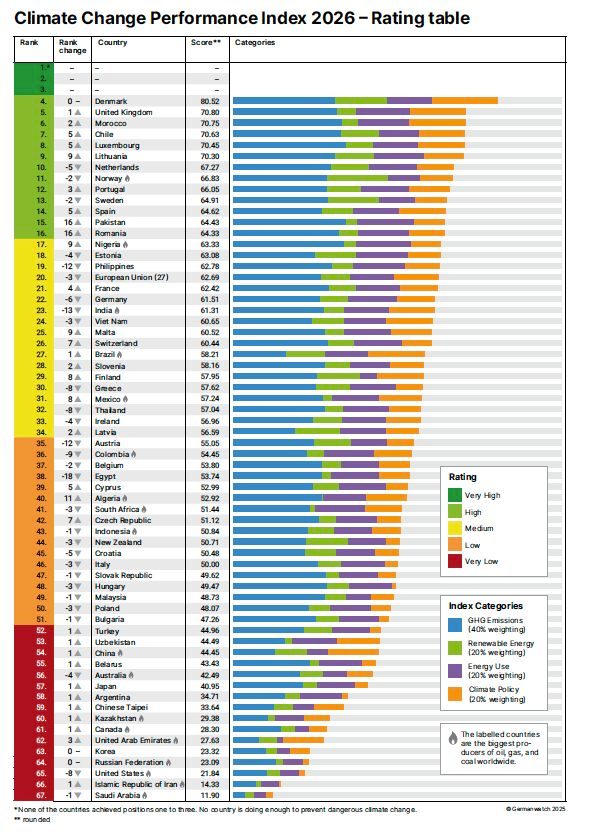
However, Climate Change or, more realistically, the Climate Catastrophe, will destroy many business models which worked well in the past 50 years. The situation will worsen for several decades, even if there would be strong measures implemented to minimize pollution from tomorrow morning. In fact, even this is not happening. The new CCPI Climate Change Performance Index 2026 confirms that global efforts are still far away from tackling the biggest crisis of mankind in an effective way.
The expansion of renewable energy, with global capacity almost doubling in the last decade and a slight slowdown in the growth rate of Greenhouse gas since 2015, is a positive sign. However, emissions are still rising despite existing technology and expertise, as no decisive and sustained political action can be recognised in any of the countries of the world. The CCPI 2026 shows that only one country, namely Denmark, reaches an index value of just above 80%, calculated on the basis of four criteria. Less than ten countries are at least above 2/3 of the index value.
In contrast to the intensive PR offensives and green storytelling, the UAE and the KSA are among the countries at the bottom of the table. The Philippines, India, and the USA have done the deepest falls in the ranking compared to the previous CCPI. Pakistan, Romania, and Algeria are the three rather unexpected biggest climbers.
The first quarter of the 21st century is coming to an end in a few weeks. Meaningful Tourism can be a powerful tool to avoid at least to put more oil in the already raging fire, albeit with the clear perspective that it is very unlikely that at the end of the second quarter of this century there will still be international leisure tourism beyond the mobility of a small number of very rich and powerful people. That should not stop us from creating the best possible ways in which tourism can provide objective benefits and subjective satisfaction to all stakeholders involved.
Source:
 Roberta Boscolo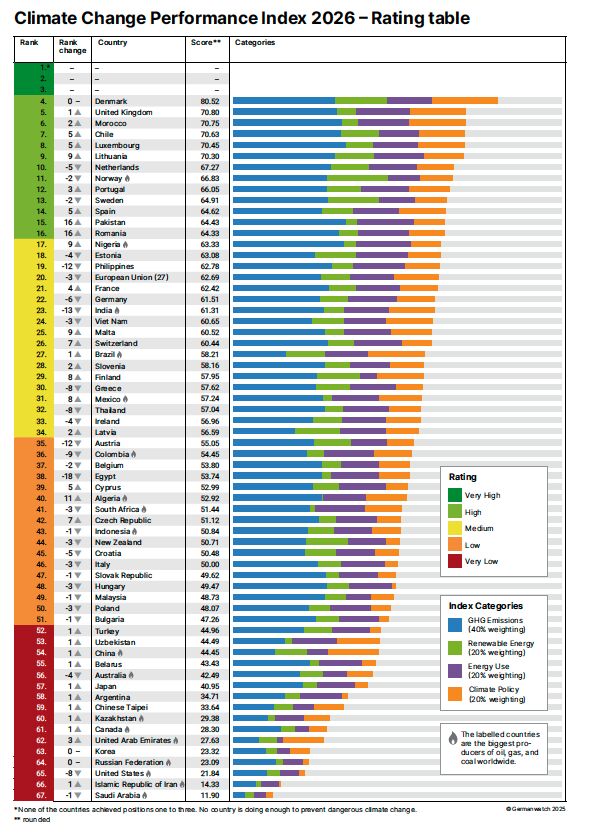
As always, all good wishes from Prof. Dr. Wolfgang Georg Arlt (PROF M) and the entire Meaningful Tourism Weekly team in Kathmandu and Manila!

Online Lectures about Meaningful Tourism continue
After eight Online Lectures on the importance of Meaningful Tourism for five African countries and three South Asian destinations in the first two weeks of December 2025, the Online Lectures continue with three more lectures for Africa and South Asia, presenting more details about how to implement Meaningful Tourism.
As of today, the second Online Lecture for South Asia and the second and third for Africa have already been broadcast successfully; they can all be found as videos on the website of our partner, the Institute of Tourism.
On December 22, South Asia Lecture 3 will be available live, and on December 29 and 30, the last lecture will introduce a step-by-step approach for the successful implementation of the Meaningful Tourism tools.
Register for these lectures free of charge here 👇🏼
 r
r
Year-end Edition 2025 of the Meaningful Tourism Weekly on December 30, 2025
Next week, the Meaningful Tourism Weekly is taking a Christmas break. However, on December 30, 2025, one day earlier as to avoid coalition with the New Year celebrations in many parts of the world, Meaningful Tourism Weekly will take a look back on a year which brought great progress for the Meaningful Tourism approach, but at the same time also drove the point home that Climate Change and its consequences are developing even faster than the worst case scenarios predicted and that AI is writing new rules for almost anything on earth, from warfare to HRM and from decision making to distribution channels in tourism and many other industries.
In this extended Year-end edition, MTC will also unveil the new structure of the Meaningful Tourism Weekly from January 2026 onwards and give an extensive update on the growing range of offers and services MTC and its many Certified Trainers around the world have prepared for you for 2026.
All good wishes from the Meaningful Tourism community for a festive season that is as peaceful as possible!

Special section on Meaningful Tourism in the next edition of the Bali Journal of Hospitality, Tourism and Culture Research (BJHTCR)
Assoc. Prof. I Nengah Subadra, Faculty of Business, Tourism and Education, University of Triatma Mulya, Bali, the MTC-certified trainer for Southern Indonesia, is also the editor of the BJHTCR. MTC is very grateful to him for his willingness to be one of the editors of a special section in the upcoming edition of the academic journal, which looks at Meaningful Tourism in Africa and Asia.
The December 2025 edition is planned to be available at the end of the year and will be online for free download. Readers of Meaningful Tourism Weekly will be among the first informed about the URL which will open the treasure chest of insights from many authors of the Meaningful Tourism community.
Meaningful Tourism Community: The Meaningful Tourism Transformational Game Workshop Trainer
Raveesh Mrigendra, Trainer for North India
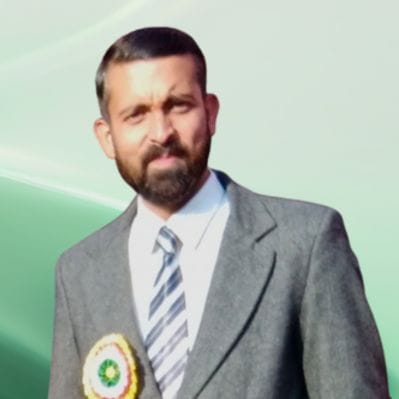
Raveesh Mrigendra is a Ph.D. Research Scholar in the Department of Tourism & Travel Management, School of Tourism, Travel and Hospitality Management, Central University of Himachal Pradesh, Dharamshala, India.
Previously, he has worked as a social worker, as a staff member in a resort, and as a Vocational Trainer (Tourism & Hospitality) in Government Senior Secondary Schools of Himachal Pradesh.
Meaningful Tourism Weekly: What is the current situation of tourism in North India and how can the Meaningful Tourism Paradigm help to support its development?
Raveesh: Tourism in India today is at a crossroads where rapid growth is witnessing complex challenges. The sector significantly contributes to the national economy and provides employment across urban and rural regions. Simultaneously, this growth has also raised apprehensions concerning environmental pressure, erosion of cultural values, and uneven distribution of benefits accruing from tourism.
North India, with its Himalayas, pilgrimage circuits, heritage cities, and countryside, attracts a large number of domestic and international visitors.
However, many destinations are facing challenges such as overcrowding, waste management issues, unregulated construction, and seasonal economic instability. Communities in these areas often remain at the margin of decision-making and receive limited economic returns from tourism activities.

The Meaningful Tourism paradigm offers a constructive way forward by advocating tourism that creates balanced value for all stakeholder groups, namely, visitors, host communities, tourism providers, local governments, and the natural environment.
It calls for destinations to design tourism products and experiences aimed at deepening the visitor engagement with the local culture and nature, ensuring fair distribution of incomes, strengthening local identity, and conserving ecological resources, instead of merely meeting the number of tourists.
For North India, this may translate into community-based models of tourism, small-scale entrepreneurship, interpretation programs aimed at encouraging respectful behaviour, local product development, controlled carrying capacity plans in ecologically fragile zones, and training programs that uplift the local youth as guides and stewards of heritage.
Meaningful Tourism supports long-term resilience through shifting tourism from volume-driven to value-driven. As a certified trainer of Meaningful Tourism, I seek to support stakeholders in adopting this paradigm so that tourism in India grows in ways that enrich visitors, empower host communities, and protect cultural and natural heritage for future generations.
MTC Certified Trainers
Please find below the updated overview of all our Certified Trainers for the Meaningful Tourism Transformational Game Workshop, along with the updated World Map showing the countries directly and indirectly covered at present.
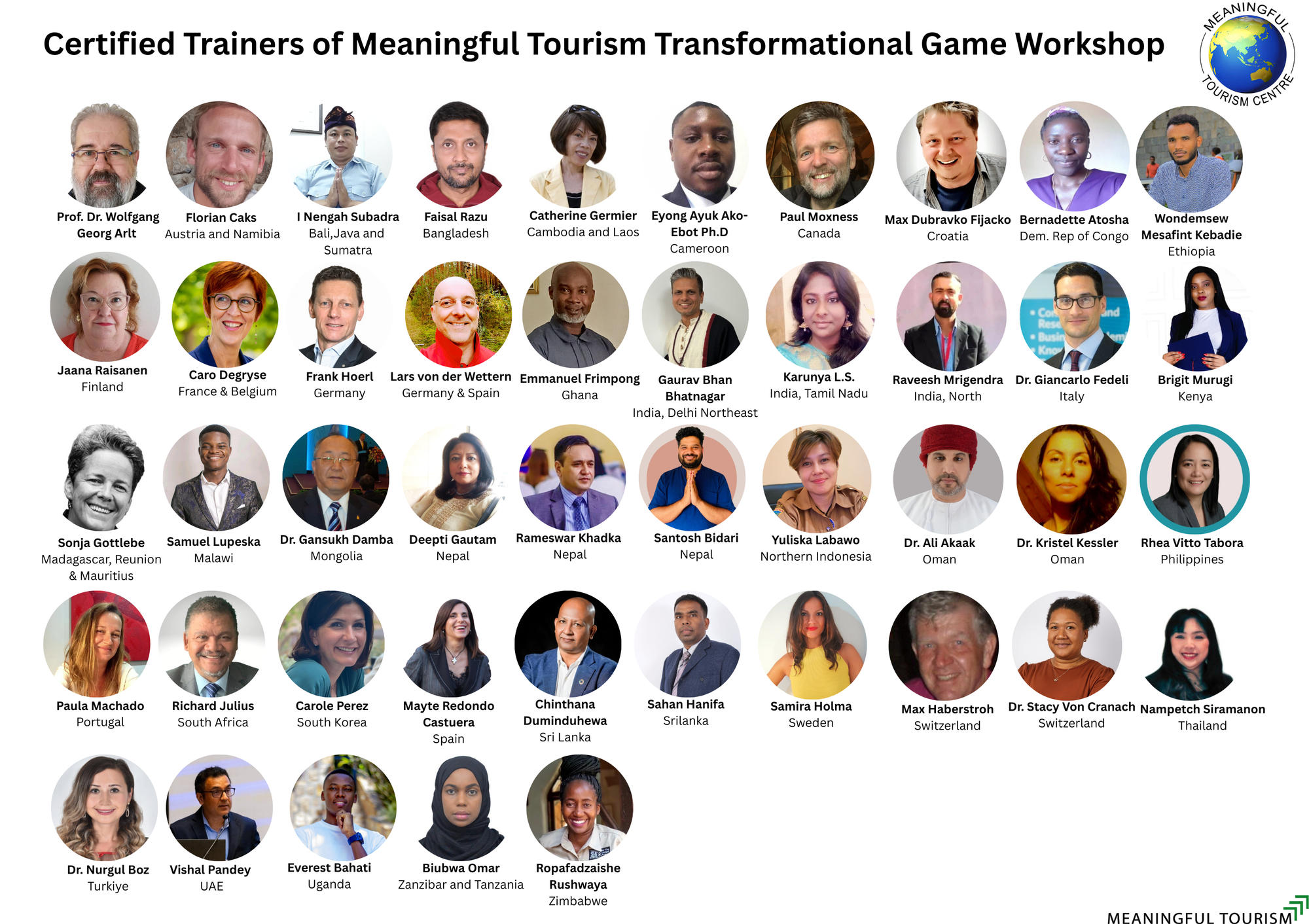
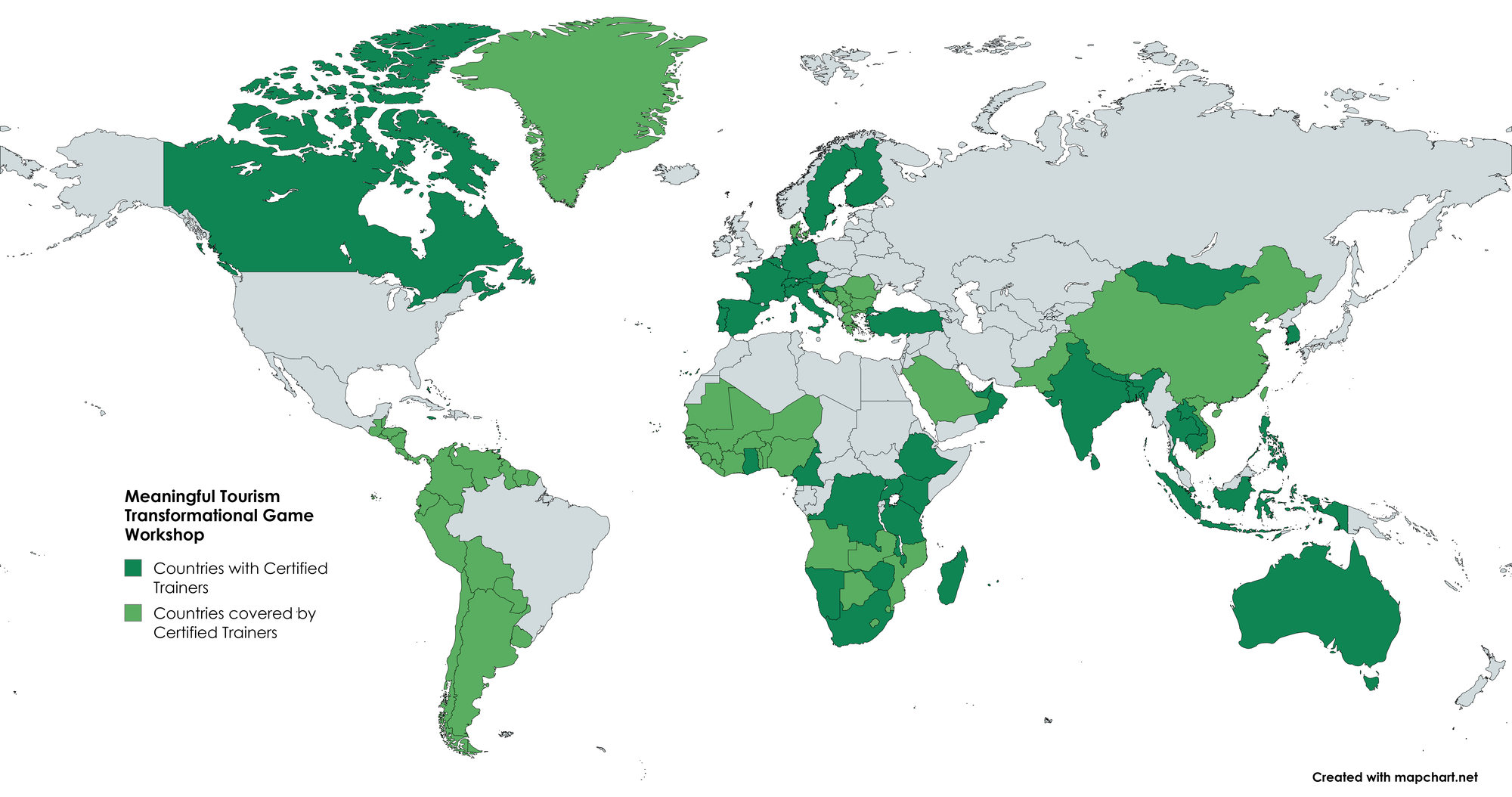
With almost 50 Certified Trainers, many countries and regions of the world are already covered. However, MTC continues to look for professionals with experience in training or lecturing and a passion for sustainable tourism.
If you are interested in becoming a Certified Trainer for the Meaningful Tourism Transformational Game Workshop for a country not marked in dark green on the map above, please contact us at office@meaningfultourismcentre.org.
Africa Online Lecture
Remaining schedule: December 30, 2025 (Tuesday)
Starting at 9:30 a.m. GMT (11:30 a.m. SAST)
Duration: 45 minutes plus 15 minutes Q&A
Online Lecture 4 (Dec 30): A step-by-step implementation of Meaningful Tourism for destinations, companies, and organisations, plus a conclusion and outlook into the coming years.
Register here 👇🏼
 r
r
South Asia Online Lectures
December 22 and 29, 2025 (Monday)
Starting at 8:00 a.m. GMT (1:30 p.m. Indian standard time)
Duration: 45 minutes plus 15 minutes Q&A
Online Lecture 3 (Dec 22): A holistic approach and an example of how to earn money from sustainable behaviour
Online Lecture 4 (Dec 29): A step-by-step implementation of Meaningful Tourism for destinations, companies, and organisations, plus a conclusion and outlook into the coming years.
Participation remains free of charge. However, you need to register to receive a Zoom link for each Online Lecture.
Register here 👇🏼
 r
r
About Meaningful Tourism Weekly
Meaningful Tourism Weekly is published every Thursday by Meaningful Tourism Centre (MTC) - London and Kathmandu in collaboration with Travel Asia Now, led by Rhea Vitto Tabora.
Each issue features an Editorial, updates on MTC activities, a Best Practice Example, a profile of an MTC-certified trainer, news about upcoming events, and, occasionally, additional op-ed pieces from guest authors. Carefully selected news items, including videos and podcasts, are also included, with links to their original sources in the Meaningful Tourism News section.
Subscription to Meaningful Tourism Weekly is free, with the addition of a paid content section that includes a library of surveys, exclusive articles, conference presentations, and statistical data, offering subscribers invaluable resources.
Sponsorship opportunities are available for those interested in supporting this initiative.
For more information about MTC's training programs, market research, product adaptation, consulting services, conferences, strategy development, and marketing, visit our website or email us at info@meaningfultourismcentre.org.